
Bad Bunny, Puerto Rico and the Politics of the 2026 Super Bowl Half-Time Show

Updated: Feb 25
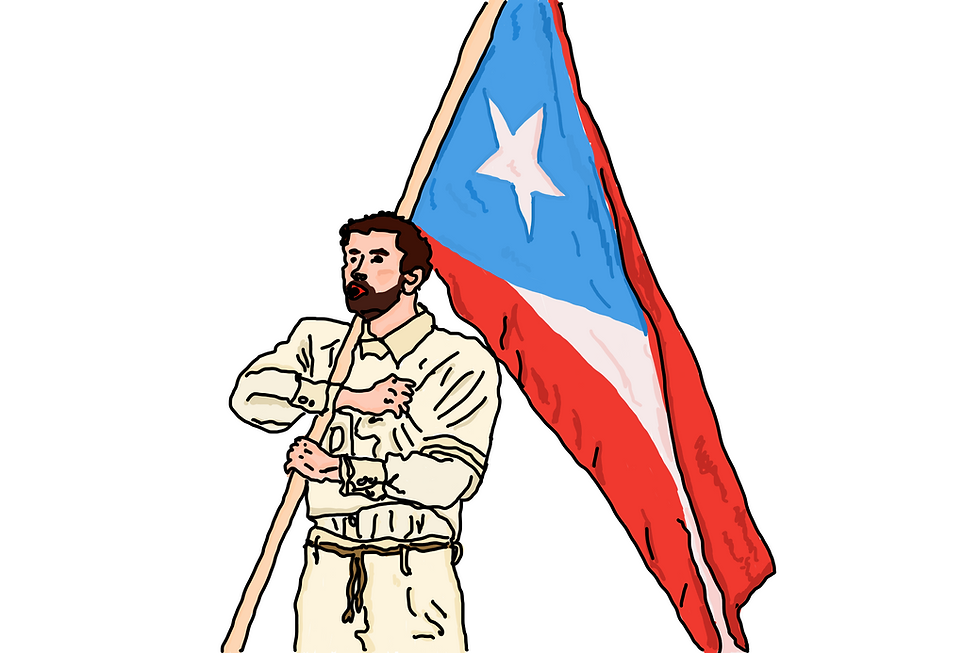
Just over a week after the Super Bowl LX in San Francisco, the noise has settled enough for me to do a deep-dive cultural analysis of Bad Bunny's iconic half-time show through a Hispanic gaze.
Before delving into the symbolism of his performance and the wider political landscape in the Americas, it's worth noting that Bad Bunny's half-time show came at a defining moment in his career. Just weeks earlier, his album, DeBÍ TiRAR MáS FOToS, became the first Spanish-language album to win Album of the Year at the Grammys.
Even before Bad Bunny hit the half-time stage, the ever-more familiar machinery of the US culture wars had already kicked in. As soon as the Puerto Rican superstar's performance was announced, political figures aligned with President Trump attacked the decision to have Bad Bunny headline the half-time show. They called for alternative programming, leading to a different show being cobbled together, the so-called "All-American Halftime Show", with white country singers headlining. The messaging was hardly subtle, and it was most certainly not lost on Puerto Ricans, who are, to the amazement of some, US citizens. Ironically, in the immediate aftermath of the halftime show, videos emerged on social media of prominent Trump loyalists watching Bad Bunny's performance anyway. But predictably, following the performance, President Trump called for an investigation into the supposed "appropriateness" of the show. The less said about that, the better.
Even setting aside the Spanish-language dimension of the performance for a moment, there had long been a sense that this halftime show would carry political weight. In the months leading up to the event, Bad Bunny made headlines by deliberately leaving the United States off his touring schedule, explaining that he was “very concerned” about the possibility of ICE agents appearing outside his concerts. He did not want his shows to become sites where Latino communities might feel targeted. For many Latino families in the United States, immigration enforcement is not an abstract policy debate, but a daily reality shaped by raids, detentions and an increasingly aggressive rhetoric in the media landscape. Viewed in that context, his decision to step onto the Super Bowl stage was never going to be interpreted as neutral entertainment. It was always likely to be read, both by supporters and by critics, as a cultural and political moment, whether or not he chose to address those themes explicitly on stage.
The Spanish Language at the Super Bowl before 2026
Bad Bunny’s decision to perform entirely in Spanish stands out even more when viewed against the history of Hispanic artists at the Super Bowl halftime show, where performers almost always appeared within English-language productions.
In 1992, Gloria Estefan performed "Live for Loving You" and "Get on Your Feet". While her set had unmistakable Cuban rhythmic influences reflecting her heritage, both songs were performed in English. When Estefan returned in 1999 as part of a multi-artist halftime show, she once again performed in English, reinforcing how even established Hispanic stars were expected to fit the linguistic norms of the broadcast. Subsequent appearances by Hispanic (and Hispanic-heritage) performers such as Enrique Iglesias and Christina Aguilera were also in English, rather than Spanish.
2020: Shakira, Jennifer Lopez and the Bilingual Turning Point
It was not until 2020, when Jennifer Lopez and Shakira co-headlined the halftime show in Miami, that Spanish began to occupy a far more visible space on the Super Bowl stage. Both artists still performed English-language hits as part of their crossover catalogues, but the simple fact that two Latina performers carried the entire headline show marked a major shift in representation. The inclusion of Bad Bunny (his first performance at the Super Bowl) and J Balvin as guest performers reinforced that moment.
The pairing highlighted two different Latino realities that reflect the paths their careers have taken. Shakira, a Colombian artist who built her fame first across Latin America and entered the U.S. market already established in the Spanish-speaking world. Jennifer Lopez, Puerto Rican by heritage but raised in New York, reflects the long-standing U.S. Latino diaspora, where identity is shaped by bilingual life and generations growing up between cultures. Together, their presence captured the range of Latino communities in the United States, from internationally rooted people to families whose ties to the country span decades.

Spanish-speaking audiences sometimes tease Lopez for her uneven Spanish fluency, including the well-known “mi gente latino” slip. Yet she has consistently used major stages to highlight Latino visibility and Puerto Rican identity. One of the most powerful visuals of her Super Bowl performance came when she wore a feathered coat that opened to reveal the Puerto Rican flag on one side and the United States flag on the other. The image reminded viewers of Puerto Rico’s unresolved political status and the millions of Puerto Ricans living across the United States.
Another moment that generated intense discussion was when Lopez’ daughter, Emme, her child with Puerto Rican singer Marc Anthony, appeared on stage. The staging around her was widely interpreted as referencing children held behind detention fencing during the migrant family separation policies of the first Trump Presidency. At the time, thousands of migrant children had been separated from their parents and placed in detention facilities, making the symbolism unmistakable for many viewers. Lopez then closed her set with “Let’s Get Loud,” which was seen as a clear call for Latino visibility, presence and representation in American public life.
2026: Bad Bunny Puts Puerto Rico at the Centre of the Stage
Bad Bunny’s half-time show felt different to the 2020 half-time show because the performance followed a clear historical thread anchored in Puerto Rico. The set design, musical choices and visual symbolism repeatedly told the realities of Latino people, both in the USA and in general. Here are some of the most visible symbolic gestures that shaped the performance.
Firstly, one of the clearest visual details was the lighter shade of blue used in the Puerto Rican flags displayed throughout the show. The lighter sky-blue tone has historical roots in independence-era versions of the flag from the late nineteenth and early twentieth centuries. The darker navy shade later became the official standard during the twentieth century. The lighter blue has never been outlawed, but it has long carried strong nationalist symbolism on the island. Its presence on the Super Bowl stage was clearly intentional and immediately fed into the long-running debate about Puerto Rico’s political future.

Secondly, the staging with performers dressed as sugar cane taking over the pitch directly referenced the Caribbean island’s troubled plantation past. It pointed to the colonial sugar economy that shaped Puerto Rico’s early modern history and relied heavily on enslaved labour.
A central, and perhaps overlooked, moment came through the Puerto Rico-Hawaii comparison, reinforced by Ricky Martin’s performance of "Lo Que Le Pasó a Hawaii". The song draws parallels between the two archipelagos, both shaped by US expansion, tourism-driven development, military presence and long-standing debates about sovereignty. The segment highlighted concerns about land displacement, gentrification and the transformation of local economies around external investment. It was one of the most overtly political sections of the performance.
Bad Bunny’s clothing also carried layered symbolism and quickly ignited debate. The jersey marked “Ocasio 64” has been interpreted in multiple ways. Some link it to a late relative, but the number 64 also resonates deeply in Puerto Rico because it echoes the long-contested 64 deaths in the official toll initially reported after Hurricane María in 2017. Later studies estimated the disaster’s death toll at 2,975, once deaths linked to infrastructure collapse, medical disruption and prolonged power outages were included. The gap between the early official figure and later findings remains one of the most politically charged conversations in Puerto Rico to this day.
Viewed through that lens, the number also connects to broader debates about the federal response to the disaster. Emergency aid for Puerto Rico in the immediate aftermath was widely criticised as slow and limited, even though long-term allocations later reached tens of billions of dollars. By contrast, Hurricane Harvey, also in 2017, but in Texas, received rapid congressional emergency appropriations within weeks. Hurricane Harvey caused roughly 68 direct deaths and over 100 indirect deaths, while Hurricane María’s total mortality impact was ultimately far higher once long-term effects were counted. The differences in speed, scale and delivery became central to debates about Puerto Rico’s territorial status and its relationship with the mainland, reinforcing a widely held perception on the island that federal priorities do not treat Puerto Rico as equal to U.S. states.
Finally, the end of the show delivered a linguistic gesture that generated immediate discussion. After saying “God bless America,” Bad Bunny referenced countries across North, Central and South America while their flags appeared behind him. In many Spanish-speaking and some southern European countries, geography is taught using a six-continent model in which the Americas form a single continent rather than two separate ones. The moment played on that distinction, reminding viewers that the word “America” can refer to the entire hemisphere, not only the United States. In the Anglosphere this framing can seem pedantic, but the point landed clearly, and annoyed the right (pun intended) people.
How Puerto Rico became “American” without becoming America
Now that we have looked at the symbolism of Bad Bunny’s performance and the recent political context surrounding Hurricane María, it is worth stepping back to understand how Puerto Rico came to occupy its unusual position within the United States.
From a European historical perspective, Puerto Rico entered the imperial world in 1493, when Christopher Columbus reached the territory under the Spanish Crown. The landmass was already home to the Taíno, whose cultural legacy remains visible in archaeological sites such as ceremonial batey ball courts and whose genetic ancestry continues to form a measurable part of the modern Puerto Rican population, despite the devastating demographic collapse caused by European disease, forced labour and colonial violence.
Spanish settlement began in 1508, and Puerto Rico quickly became strategically important as a military outpost. Its geographical position mattered enormously. Almost all ships returning to Spain from the Caribbean and parts of mainland Latin America passed through the waters between Puerto Rico and Hispaniola (modern-day Dominican Republic and Haiti). Puerto Rico’s early colonial importance was therefore strategic rather than developmental. It existed primarily to defend shipping routes and protect imperial wealth extracted elsewhere.
By the nineteenth century, independence pressures on the territory had begun to surface. The Haitian Revolution of 1804, the only successful large-scale slave revolution in modern history, profoundly reshaped the Caribbean political landscape and terrified colonial authorities across the region. In response, Spanish administrators encouraged European immigration and promoted demographic policies often described in Spanish sources as “blanqueamiento” (whitening), designed to reshape the population balance. Nationalist sentiment on the island continued to grow, culminating in the Grito de Lares in 1868, an organised uprising in which independence activists declared a short-lived republic in the town of Lares. The rebellion lasted only a matter of days before being suppressed, yet it became one of the foundational symbols of Puerto Rican nationalist memory.
Only three decades later, the territory’s geopolitical fate changed dramatically. In 1898, the explosion of the US battleship USS Maine in Havana harbour, Cuba, was used by the United States as a justification to declare war on Spain. Subsequent investigations have never conclusively proven Spanish responsibility, and many historians today argue that the cause was likely an internal explosion rather than an external attack. Nevertheless, the incident served as the political pretext for the Spanish-American War, which ended the same year with the Treaty of Paris (1898). Spain ceded Puerto Rico, Guam and the Philippines to the United States, marking the beginning of Puerto Rico’s modern status as a US possession.
Upon transition to the USA, Puerto Rico was classified as an unincorporated territory, a legal category meaning the island falls under US sovereignty while receiving only partial constitutional protections. Unlike continental territories that historically followed a clearer path toward statehood, Puerto Rico’s status was designed to remain open-ended. In 1917, the Jones-Shafroth Act granted US citizenship to Puerto Ricans, the same year the United States entered World War I, coincidentally allowing Puerto Rican men to be drafted into the US military.
That same period also marked an expansion of US imperial power across the Caribbean. The opening of the Panama Canal in 1914 followed Washington’s interference in favour of Panama’s separation from Colombia, a move that ensured long-term US control over one of the most important global shipping corridors. Securing the canal also meant dominating the surrounding sea routes, and Puerto Rico’s location placed it at the centre of that strategy. The island increasingly functioned as a naval and logistical hub protecting US military and commercial interests, meaning that the same geography once used to sustain Spanish imperial trade routes was now absorbed into a new imperial network directed from Washington.
The twentieth century also exposed the scale of US state violence on the island. In 1937, the Ponce Massacre saw US-backed colonial police open fire on an unarmed nationalist march during Palm Sunday commemorations. 19 civilians were killed and more than 150 wounded, many shot while trying to flee. Investigations at the time concluded that the demonstrators posed no threat, turning the event into one of the clearest examples of political repression under US rule.
Decades later, the US Navy used the inhabited Puerto Rican island of Vieques as a live-fire military training range, conducting bombing exercises close to civilian communities. The operations continued for decades despite sustained local opposition and growing concerns about environmental contamination and public health. Large-scale protests in the late 1990s and early 2000s eventually led to the end of the exercises in 2003. For many Puerto Ricans, the episode is yet another example of how they are othered by Washington.
Those historical dynamics still shape Puerto Rico’s economy today. Many of the rules that govern the territory make daily life more expensive while limiting its ability to grow independently. For example, US shipping laws require most goods travelling between the mainland United States and Puerto Rico to be carried on US-flagged ships, which are often more expensive to operate. That extra cost is passed directly to consumers on the island through higher prices for food, fuel and basic supplies.
At the same time, previous tax incentives that once encouraged factories and large employers to operate in Puerto Rico were subsequently withdrawn, leading to major job losses without equivalent replacement investment. The combination of higher living costs, fewer large employers and limited control over economic policy has left many Puerto Ricans feeling that the system is designed to keep the island economically dependent while offering few of the advantages normally enjoyed by full US states.
The Real Legacy of Bad Bunny's Performance
Seen in its full historical context, Bad Bunny’s halftime show placed Puerto Rico’s unresolved political position in front of a global audience that rarely hears the full story. The symbolism, language and staging all pointed to the same underlying reality: Puerto Rico has spent more than a century tied to the United States in a relationship that demands responsibility while limiting political power. The performance turned what is often treated as a cultural footnote into the central conversation.
Earlier Super Bowl appearances by Latino artists focused largely on visibility and representation within the United States. In 2026, the emphasis shifted. The spotlight moved to Puerto Rico itself, its history, its contradictions and the ongoing debate about its future. By placing the island at the centre of the biggest entertainment stage in the country, the performance ensured that the political conversation surrounding Puerto Rico will be far harder to ignore in the years ahead.


